
When publishing leaders hear library binding, they often think of a stronger cover. But for publishers targeting institutional markets, it's a comprehensive manufacturing standard engineered for one purpose: extreme durability.
These books are built to survive the high-traffic, heavy-use environment of schools and public libraries. They have a significantly longer lifespan than a standard trade hardcover, and for publishers, that translates into a premium product that unlocks institutional sales and reinforces market leadership.
Why Library Binding Is More Than Just a Stronger Book
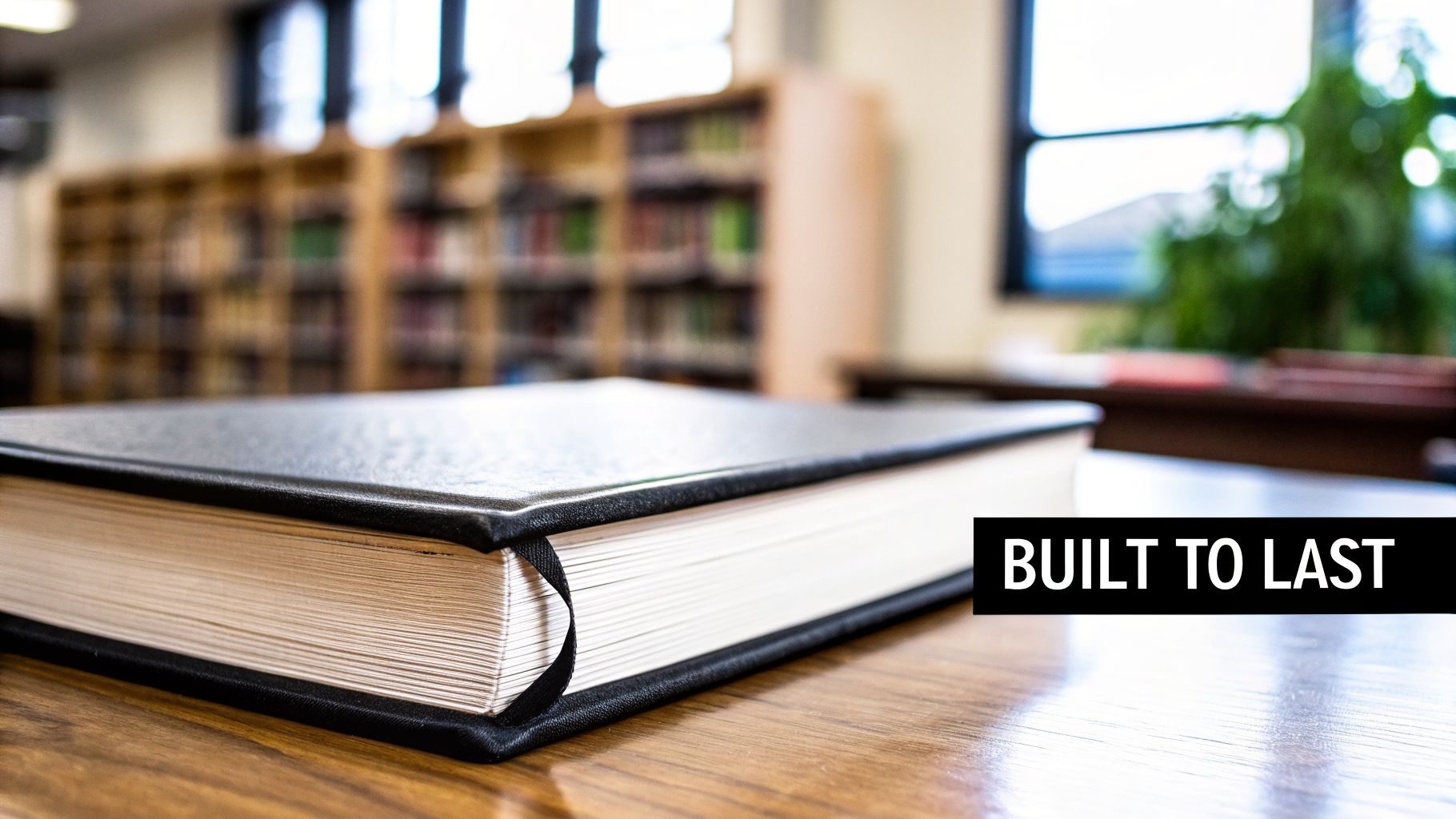
For publishers focused on the trade and educational markets, underestimating library binding is a missed strategic opportunity. Consider a construction analogy: a standard hardcover is a well-built residential home, designed for normal use. Library binding, in contrast, is commercial-grade construction—engineered to withstand constant, heavy traffic for decades.
This distinction is critical when positioning titles for the institutional market.
Librarians and school procurement officers don't just buy books; they invest in long-term collection assets. With constrained budgets, total cost of ownership is a primary driver in their purchasing decisions. A book that fails after only 20 circulations represents a poor investment, incurring additional costs for replacement or repair.
A library-bound book isn’t just a product; it’s a durable asset. Its entire construction is a direct answer to the economic realities of institutional collections, where a book's longevity directly impacts budget efficiency.
This is where the strategic advantage for publishers materializes. By offering a true library-bound edition, you’re not just selling content; you’re providing an integrated solution that aligns perfectly with the operational and financial needs of your institutional clients.
The Publisher’s Edge
Investing in superior binding provides a distinct market advantage. It's a clear signal of quality that resonates with librarians, educators, and distributors who prioritize longevity. This strategic decision can deliver several key business outcomes:
- Secure Institutional Sales: A library-bound edition is purpose-built for this channel, making it the preferred choice for library wholesalers and school districts.
- Enhance Title Value: A title's perceived—and actual—value increases when offered in a format designed for durability, justifying a premium price point.
- Strengthen Client Relationships: Providing a lower total cost of ownership for institutional clients builds your reputation as a trusted, strategic partner.
A Gateway to Broader Markets
For publishers aiming to capture the diverse English and French markets across North America and Europe, mastering these production details is a competitive differentiator. It demonstrates a deep understanding of market requirements beyond the content itself.
Specifying proper library binding ensures your titles aren't just considered for permanent collections—they’re actively sought after. To learn more, our resources for university presses offer deeper insights into serving these specialized markets.
Ultimately, choosing library binding is a strategic move. It positions your books as premium, long-lasting assets, opening the door to a stable and profitable revenue stream within the demanding institutional sector.
The Anatomy of a Superior Library Bound Book
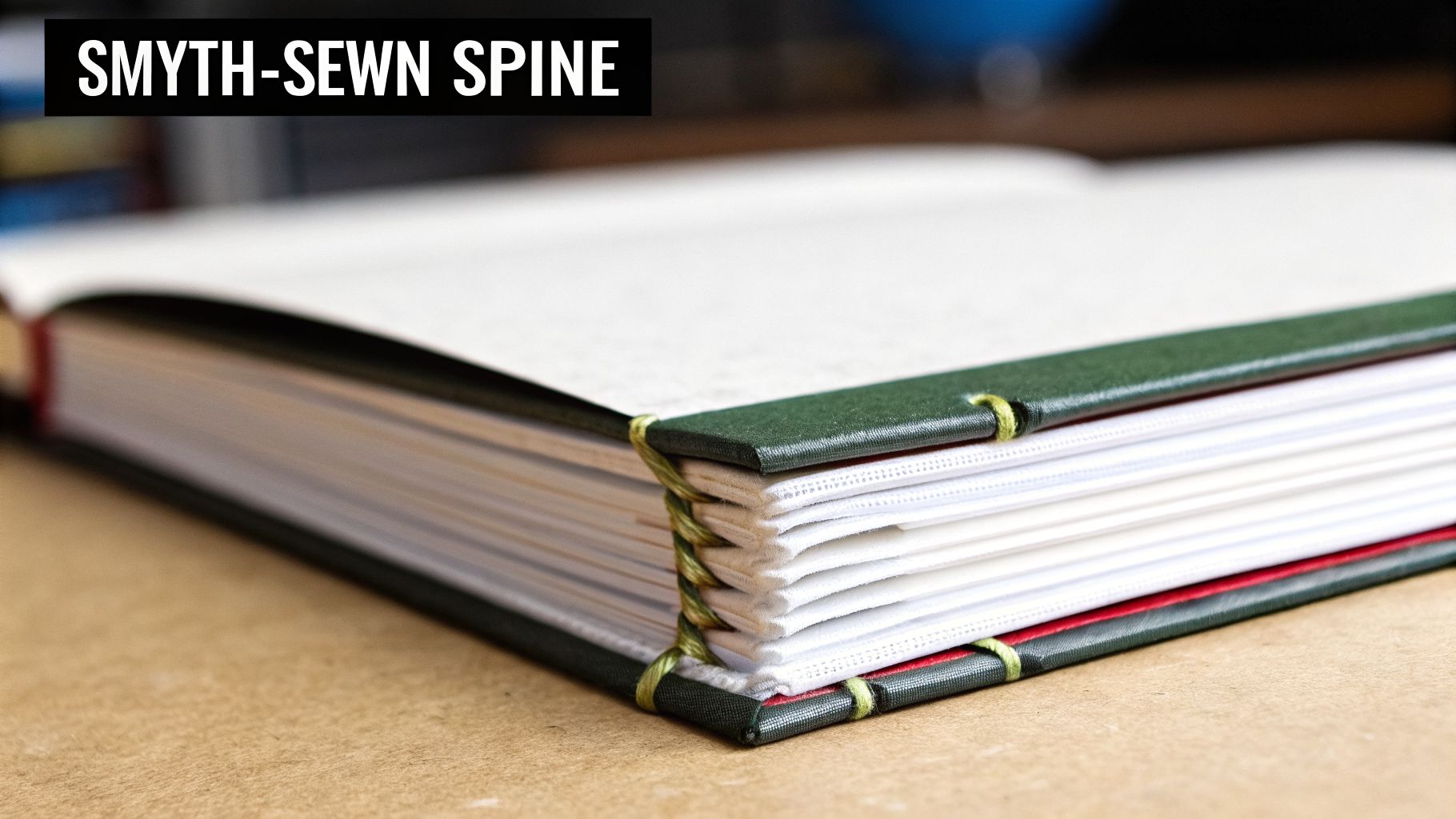
On the shelf, a standard hardcover and a library-bound book can appear nearly identical. However, their internal construction is worlds apart. For publishers seeking to be specified by libraries and schools, understanding these structural differences is crucial. The hidden details determine whether a book will last for a handful of reads or for hundreds of circulations.
Consider the difference between a passenger vehicle and a commercial transport truck. While both have an engine and wheels, every component of the truck is engineered for higher stress and a far longer operational life. The same principle applies to a library edition. It’s not just a book; it’s a piece of durable equipment designed for a specific, demanding purpose.
Smyth-Sewn Signatures: The Unbreakable Core
The heart of any truly durable book lies in how its pages are bound. The industry gold standard for library binding is Smyth-sewn signatures.
The process involves folding pages into small booklets (signatures), which are then physically sewn together with thread. This creates a single, unified textblock that is both incredibly strong and highly flexible. Pages cannot be easily pulled out—a common failure point in adhesive-bound books. Critically, the book can lie almost completely flat without cracking the spine, a key feature for readability and longevity.
For a publisher, specifying Smyth-sewn construction is the single most important decision to ensure a book’s structural integrity for the institutional market.
Reinforced Hinges and Endpapers
The flexible joint where the cover meets the book block—the hinge—is a major stress point. In a standard hardcover, a simple paper endpaper is used, which is prone to tearing after repeated openings. A single forceful tug can cause the textblock to separate from its cover.
Library binding addresses this vulnerability with a more robust engineering approach.
Reinforced endpapers, typically featuring a sturdy cloth strip made of cambric, create an exceptionally strong and flexible hinge. This reinforcement acts like a ligament, absorbing the strain of thousands of openings and keeping the cover firmly attached for the life of the book.
While it may seem like a minor detail, it is a key indicator of quality that librarians and procurement officers actively look for. It is a clear signal that the book was engineered for longevity. You can explore how different bindings, papers, and coatings work together to create a superior product.
Superior Cover and Spine Materials
A book’s cover is its first line of defense. Instead of standard paper-based materials, library editions are wrapped in high-strength cloths like buckram. This is a stiff, durable cotton cloth treated to resist moisture, scuffs, and tears, making it ideal for withstanding heavy institutional use.
The spine is constructed with equal rigor, often reinforced with multiple layers to prevent crushing or warping from repeated removal from tightly packed shelves. This robust structure protects the sewn pages within and maintains the book's integrity throughout its service life.
The economic payoff is significant. Industry data demonstrates that professionally produced library-bound books can reduce replacement frequency by up to 75%—a substantial cost saving for any institution.
Comparing Library Binding with Case and Perfect Binding
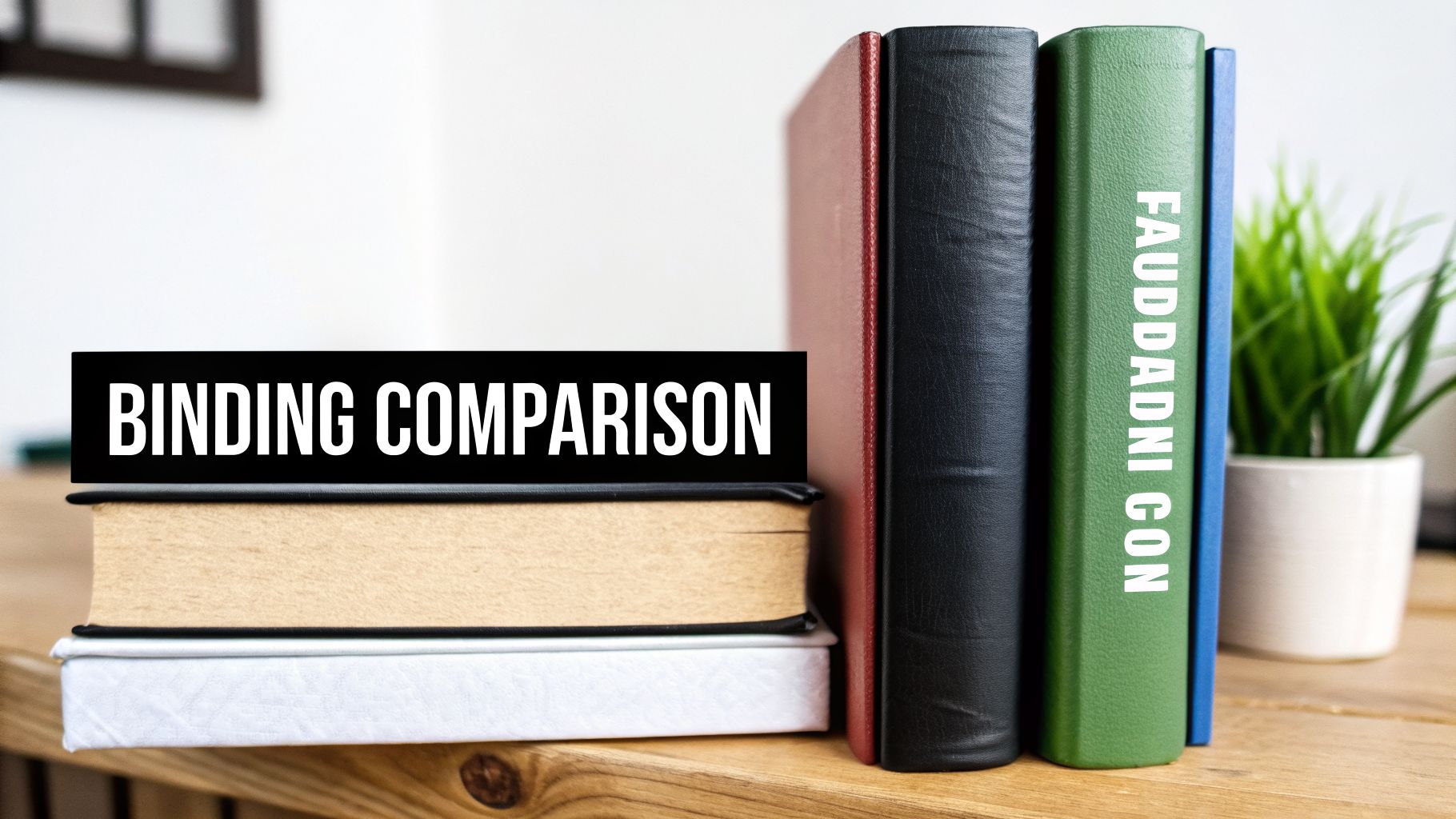
For publishers, selecting the right binding is a strategic decision that dictates a book's market viability, lifespan, and profitability. It's a common misconception that a standard retail hardcover is merely a slightly less durable version of a library-bound book. While they may appear similar externally, they are engineered for entirely different ecosystems. The choice is not about "good" versus "bad" but about aligning the product with its intended market.
Perfect Binding: The Paperback Workhorse
Perfect binding is the engine of the mass market. In this method, pages are stacked, the spine is ground flat, and a strong, flexible adhesive holds the textblock together inside a paper cover.
Its primary advantages are speed and cost-efficiency, making it ideal for mass-market fiction, trade paperbacks, and any title where a low consumer price point is critical. The trade-off is durability; the adhesive-only construction is susceptible to cracked spines and loose pages under heavy use.
Case Binding: The Classic Retail Hardcover
Case binding is the standard for what is commonly known as a "hardcover." The book’s pages are either glued or, for more premium editions, Smyth-sewn into a textblock. This block is then attached to a rigid cover (the "case") using endpapers.
This represents a significant step up in quality from a paperback, providing a durable, high-value feel appropriate for new releases, special editions, and personal collections. However, while built to last in a home environment, it lacks the structural reinforcement required for the relentless demands of institutional use.
At its core, the difference is strategic. Case binding is for the consumer market, creating an aesthetic object for a personal library. Library binding is for the institutional market, engineered from the ground up as a durable asset for a shared collection.
Library Binding: Engineered to Endure
Library binding is not a style; it is a stringent manufacturing specification. It combines the strongest structural elements—like Smyth-sewn pages that lay flat—with heavy-duty components such as reinforced hinges and robust buckram cloth covers. Every component is selected with a single goal: to survive in a high-circulation environment.
This is the gold standard for publishers selling into schools, universities, and public libraries. While the upfront unit cost is higher, the investment delivers a superior return. A library-bound book can easily withstand 100+ circulations, making it a far more economical purchase for institutions over the long term. This choice demonstrates an understanding of your clients' operational needs and a commitment to providing lasting value.
To see how these three methods compare from a strategic publishing perspective, review this breakdown. It clarifies where each binding delivers maximum value.
Binding Method Comparison for Publishers
| Attribute | Library Binding | Case Binding (Trade Hardcover) | Perfect Binding (Paperback) |
|---|---|---|---|
| Page Attachment | Smyth-sewn signatures for maximum strength and lay-flat capability. | Often glued (adhesive bound), sometimes Smyth-sewn for "special editions." | Adhesive bound (glued) spine only. |
| Durability | Highest; designed to withstand 100+ circulations. | Medium; suitable for personal use but vulnerable in high-use settings. | Lowest; prone to spine cracking and page loss with repeated use. |
| Cover Material | Heavy-duty buckram cloth over rigid binder's board. | Paper or cloth over binder's board. | Flexible cardstock, often with a laminate finish. |
| Hinge Strength | Reinforced with cloth for exceptional tear resistance. | Standard paper endpapers create a weaker hinge. | The cover itself acts as the hinge, a common point of failure. |
| Ideal Market | Public libraries, K-12 schools, university presses, and reference collections. | Consumer retail bookstores, book clubs, and gift markets. | Mass-market retail, airport bookstores, and high-volume/low-cost titles. |
| Cost Profile | Highest upfront unit cost, but lowest total cost of ownership for institutions. | Moderate upfront cost with a strong perceived value in retail. | Lowest upfront unit cost, enabling accessible consumer pricing. |
Ultimately, aligning your binding choice with your market strategy from the outset ensures your book is built to succeed, whether it's destined for a quiet personal library or the demanding hands of a hundred readers.
Meeting Durability Standards for North American Markets
Securing placement in North American library collections requires more than a compelling title; it demands a product engineered to withstand the rigorous, high-circulation environment. While formal benchmarks like the ANSI/NISO/LBI standards exist, what procurement officers across the United States and Canada truly seek is tangible proof that a book is built to last.
For publishers, this isn't about memorizing complex regulations. It's about integrating key production specifications into the manufacturing process from the start. Getting this right ensures your titles not only gain acceptance but also build your reputation and secure long-term institutional sales.
The Tangible Specifications That Matter
Beyond foundational elements like Smyth-sewing, several other details signal to a librarian that your book is a sound investment. A knowledgeable printing partner understands these specifications intimately, helping transform a standard book file into a genuinely library-ready product.
Key details that make a significant difference include:
- Generous Margin Space: Library books are often rebound during their lifecycle. Planning for this is essential. Providing at least one inch of gutter margin (the inside margin) is critical to ensure no text is lost during repair or rebinding.
- Correct Paper Grain Direction: Paper has a grain, and its direction matters. Ensuring the grain runs parallel to the spine is a non-negotiable detail. This prevents pages from warping or resisting the binding, helping the book lie flat and resist damage over years of use.
- Archival-Quality Materials: Libraries are, by definition, archives. The use of acid-free paper is an absolute requirement. It prevents pages from yellowing and becoming brittle, ensuring the book remains a valuable part of a collection for decades.
When a publisher invests in these specifications, it sends a clear message to institutional buyers. It demonstrates an understanding not just of bookmaking, but of creating a lasting asset for their community.
Durability Is Your Best Sales Pitch
In the North American library sector, print books remain circulation workhorses. A simple fact drives purchasing decisions: library-bound editions can last 5 to 10 times longer than a typical trade edition. For budget-conscious schools and universities, that longevity translates to a lower total cost of ownership—a powerful sales proposition.
This durability also integrates seamlessly with modern logistics for automatic stock replenishment, keeping high-demand titles consistently available. By collaborating with a printer who understands these requirements, you can easily build these specifications into your production workflow.
Marquis offers a comprehensive North American book printing platform designed to handle these exact specifications, helping publishers produce books that meet and exceed institutional expectations.
Ultimately, building books to these durability standards is a strategic imperative. It mitigates the risk of rejection by distributors and libraries, strengthens your brand's reputation for quality, and positions your titles for a long and profitable life in a competitive market. It demonstrates that you are a publisher who builds books not just to be read, but to endure.
Understanding the technical aspects of binding is one thing; applying that knowledge to a publishing program is where strategic advantage is created. Making the right binding choice can determine a title's success, ensuring the physical product is perfectly aligned with its intended audience and lifecycle. To achieve this, publishers often apply principles of product management for media publishers, which connects editorial decisions with overarching business goals.
Let's examine this through real-world publishing scenarios. The optimal choice for a dense academic text is almost never the right fit for a colorful children’s picture book, even if both are destined for library shelves. Each book has a unique purpose and faces distinct physical demands.
Scenario 1: The University Press Textbook
For a university press publishing a core textbook, durability is not a feature; it's a fundamental requirement. These books are significant investments for students and university libraries, expected to withstand years of heavy use, highlighting, and transport. A standard case binding is simply insufficient.
In this context, library binding with Smyth-sewn signatures is the only viable option. This robust construction allows the book to lie flat on a desk for study without the spine cracking or pages coming loose. It’s how a publisher guarantees their investment results in a product that meets the high standards of the academic market, justifying its premium price and securing its place on course adoption lists for years to come.
Scenario 2: The Trade Children’s Book Series
Consider a trade publisher with a best-selling series of picture books. These titles are staples of public library story times, handled daily by countless children. They are dropped, exposed to spills, and loved with an enthusiasm that can destroy a poorly made book in weeks.
For these high-traffic titles, a reinforced binding is non-negotiable. While a full, heavy-duty buckram library binding might be excessive, a durable case laminate with Smyth-sewn pages and reinforced hinges strikes the perfect balance between strength and visual appeal. It keeps the book vibrant and intact, ready for the next reader, circulation after circulation.
Library data consistently shows that physical books are still in high demand, with children's literature leading the charge. This is precisely why publishers serving these markets need a range of binding options—from simple perfect binding for paperbacks to Smyth-sewn case laminates for library editions. With readers still deeply engaged with print, libraries need books built to last. You can learn more about these public library circulation findings and what they mean for publishers.
Scenario 3: The High-Circulation Graphic Novel
Graphic novels present a unique challenge. The art is the narrative, meaning the book must lie as flat as possible to deliver the intended reading experience. In libraries, where graphic novels are immensely popular and see constant use, a binding that resists opening leads to a broken spine and a frustrated patron.
For this market, a Smyth-sewn binding is non-negotiable. This method is key to allowing the book to open fully and lie flat, preserving the integrity of the artist's two-page spreads without stressing the spine. Paired with a durable cover, this creates a book that both honors the art form and is tough enough for the library circuit. It is a perfect example of how the right binding is a critical component of the reader's experience.
Partnering for End-to-End Production and Distribution
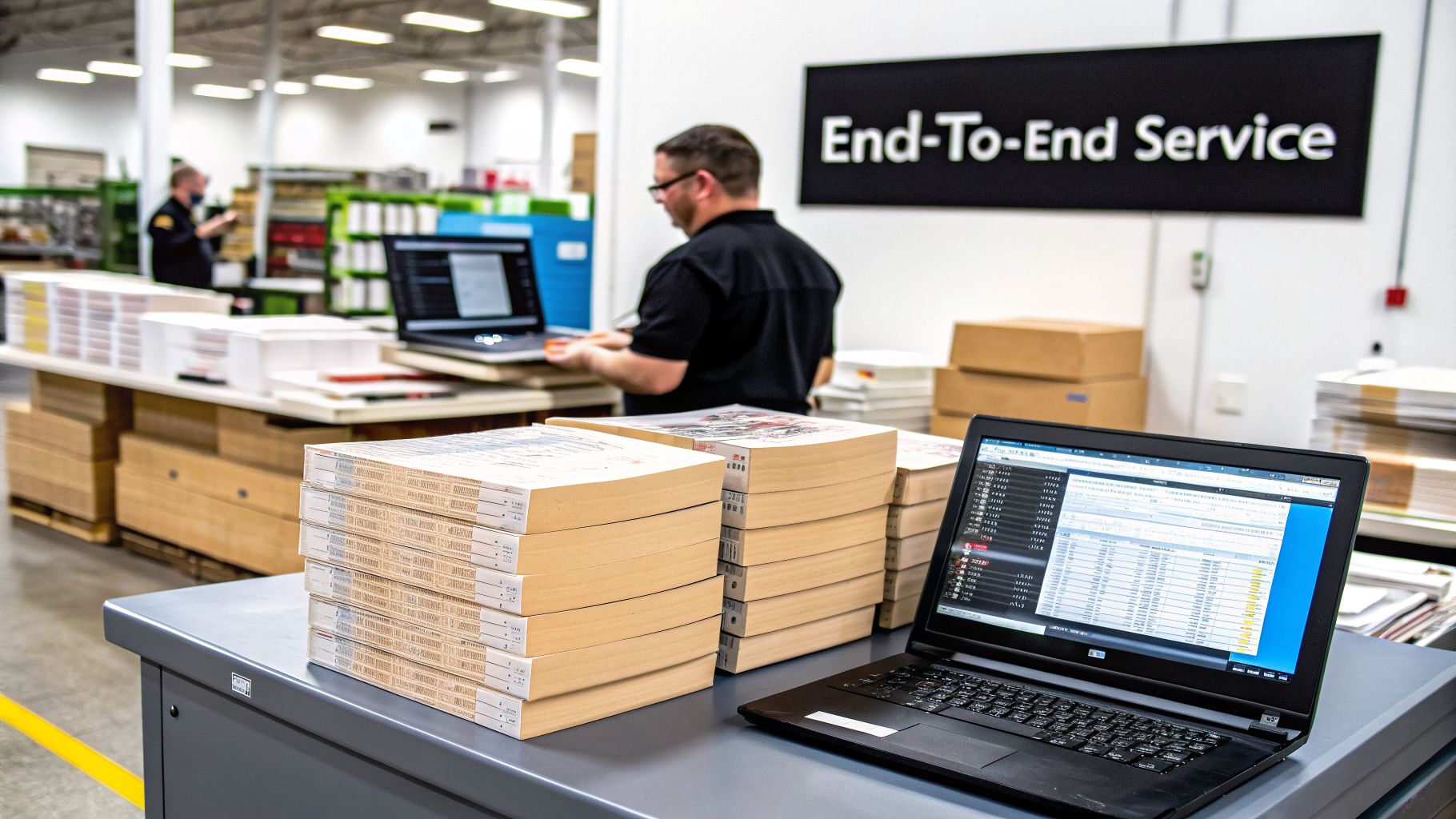
Understanding the technical specifications of library binding is one part of the equation. Transforming that knowledge into a finished book delivered to libraries across the continent is a complex logistical challenge. It requires a production partner capable of executing every step flawlessly.
For publishers, the ultimate goal isn't just creating a durable book; it's efficiently managing its entire lifecycle, from print run to end-user. This is where an integrated manufacturing and logistics partner becomes a decisive competitive advantage, offering a single-source solution to a fragmented supply chain.
From Pre-Press to North American Distribution
A true production partnership begins long before the presses run. It starts with a team that understands the specific demands of library binding books. This includes critical pre-press checks—like verifying margins are sufficient for sewing and potential rebinding, or ensuring paper grain is correctly oriented for maximum durability.
This integrated approach provides a single point of contact and accountability for the entire production ecosystem:
- The Right Printing for Any Job: Whether you need a short, on-demand run or a massive offset printing, you get access to the right technology. Digital, offset, and high-speed inkjet presses ensure every project is high-quality and cost-effective.
- Smart Inventory and Replenishment: Move beyond guesswork. Modern systems can track stock levels and automatically trigger new print runs when inventory is low, keeping key titles available without tying up capital.
- Seamless Logistics: A partner with a robust North American footprint can manage warehousing and distribution across the United States and Canada, simplifying access to both English and French-speaking markets.
For a publisher, this unified model transforms a complex series of tasks into a single, streamlined workflow. It reduces administrative overhead, minimizes the risk of costly errors, and accelerates speed-to-market.
A Gateway to the Entire Market
By centralizing production and logistics, publishers can achieve significant gains in profitability. Consolidating manufacturing, inventory management, and distribution with one expert partner eliminates the friction—and hidden costs—of juggling multiple vendors.
This model frees you to focus on your core competency: creating and curating exceptional content. You can trust your partner to manage the complexities of producing books to the highest durability standards and distributing them efficiently.
Ultimately, this kind of partnership serves as a strategic gateway to the entire North American and even European institutional markets. It’s about more than just printing a book; it’s about leveraging a full-service manufacturing and supply chain solution built to support your long-term success.
Frequently Asked Questions About Library Binding
We receive many inquiries from publishers evaluating whether library binding is the right strategic fit for their titles. To provide clarity, here are concise answers to the most common questions, based on our extensive experience producing these ultra-durable editions for the North American market.
Is Library Binding More Expensive Than a Standard Hardcover?
Yes, the upfront unit cost for a library-bound book is higher. This reflects the use of premium materials and more labor-intensive construction processes, such as Smyth-sewing the page signatures. However, the key metric for the institutional market is the total cost of ownership.
A library-bound book can last up to 10 times longer than a standard trade hardcover. For a librarian managing a constrained budget, this longevity is a compelling value proposition. It translates to fewer replacements, reduced repair costs, and greater value from every dollar allocated. Offering this format positions your titles as a smart, long-term investment for their collections.
Can I Order Short Runs of Library Bound Books?
Yes, absolutely. The era of requiring massive offset runs for specialized bindings is over. Modern digital printing and print-on-demand technologies make short runs of library-bound editions both practical and cost-effective.
This capability is a strategic advantage for publishers. It allows you to test a new title in the institutional market without significant capital investment in inventory.
It is also the ideal solution for fulfilling specific purchase orders from library distributors or for reissuing popular backlist titles as demand arises. Our on-demand platforms are engineered to simplify the management of these specialized, high-value print runs.
Do I Need to Prepare My Files Differently?
Yes, and this is one of the most critical steps in the production process. The most important specification to address is the inside margin, also known as the gutter. This is the blank space where the pages meet at the spine.
Because library binding involves sewing physically through the folded page signatures, any text or images positioned too close to the center will be pulled into the binding and become unreadable. We always recommend a gutter of at least 1 inch (25.4 mm) to ensure nothing is lost and that the book can open wide for optimal readability.
You are not alone in this process. Our expert pre-press team works directly with every publisher to review files and ensure they are optimized for a perfect, durable final product.
At Marquis, we are more than just a printer; we are your integrated partner for producing and distributing high-quality books across North America and Europe. From specialized library binding to streamlined logistics, we provide the end-to-end solutions publishers need to succeed in a global market.